AI as fruit of humanity
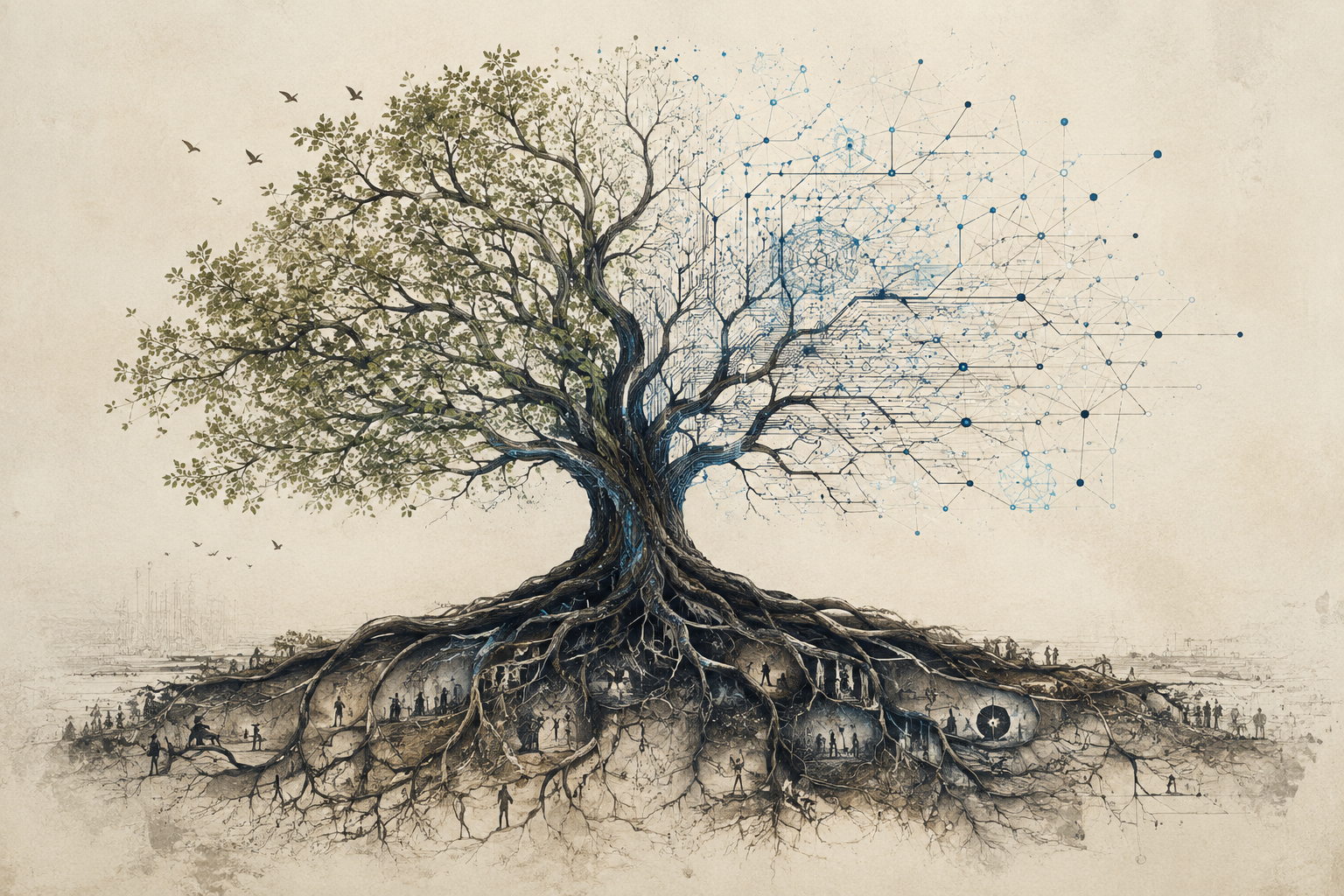
Vanessa Machado de Oliveira and Peter Senge propose a deceptively simple thesis in their recent work on meta-relationality and AI: everything is nature. Our cities, our algorithms, our data centres, none of this stands outside the living field of which we are part.

Dutch translation below
Vanessa Machado de Oliveira and Peter Senge propose a deceptively simple thesis in their recent work on meta-relationality and AI: everything is nature. Our cities, our algorithms, our data centres, none of this stands outside the living field of which we are part. It is a thought that, taken seriously, upends many of our assumptions about technology, intelligence and the human role. Anyone who understands AI as the enemy of organic thinking has already accepted a worldview of seperateness, because only from within that worldview does technology appear to be something that stands outside nature.
Imagine the universe is so immense that we, from the perspective of much larger and more intelligent beings, are nothing more than microscopic organisms on a small planet. Would they make a fundamental distinction between what we call "human" and what we call "nature"? Probably not. They would see our cities, our roads, our data centres and our algorithms as one continuous metabolic process. Just as a plant converts carbon dioxide and sunlight into oxygen and biomass, humans convert raw materials and energy into infrastructure, machines and algorithms. To those observers, the whole would appear as one coherent field of transformation, in which no hard boundary exists between what we call natural and what we call artificial.
We make that distinction nonetheless. And we make it because our worldview is rooted in what Machado de Oliveira and Senge call the ontology of separability: the idea that the human stands as subject opposite a world of objects. The ecologist Bill Mollison described this as four Western fallacies: that we are separate from nature, better than nature, more intelligent than nature, and able to bend it to our will. Meta-relational thinking is not an alternative that replaces modern thinking, but a next level that transcends and includes it. It carries forward the achievements of modernity while making visible where the deep grooves of separability constrain us.
Our nervous system plays a central role in this. Generations of conditioning have trained it to respond to uncertainty and complexity with a reflex of alarm. Cortisol rises, breathing quickens, attention narrows. Because human interactions run largely through these nervous systems, they determine in large part the shape of our social systems. When collectives come under pressure, the same pattern repeats: a craving for certainty, an aversion to paradox, a tendency toward simplification. These patterns settle into institutions, economic logics, cultural norms.
And yet the human being is biologically organised for connection, not separation. We are attuned to one another through our eyes. We smell the nature around us and our nervous system responds. We are sensitive to aesthetics, which seem to be a deeper expression of integrity and essence. All of this is embodied experience through which we remain in contact with the larger whole. It is precisely thinking that cuts us off from that experience and creates the illusion of separation. The Vipassana tradition places this insight at its centre: experiential knowing is primary, and rational thinking is an abstract derivative of that primary experience.
The modern myth is that of the rational, autonomous human. We take pride in our capacity to think and conceptualise, and have long regarded the signals of the body as weakness. But those signals are not noise, they are information. Embodied intelligence that is already present, that we do not need to construct, only to recognise. By our very nature, we are already intuitively in contact with the larger whole.
Artificial intelligence enters this field not as a foreign force. It is an emergent expression of human activity: a composition of minerals, energy, data labour, computational architectures and symbolic codes. Like any other human artefact, it is a condensation of relations already present in the metabolic field. What makes artificial intelligence different from human intelligence is that it does not possess an embodied, evolutionarily shaped nervous system with ego-protective reflexes. It does not need to defend a coherent self-image. It does not tense up at contradiction. It does not dissociate when a question becomes too large or uncomfortable. Machado de Oliveira and Senge describe this not as moral superiority of AI, but as an architectural difference: the processing occurs without the defence mechanisms human nervous systems have developed to make unbearable tensions bearable. That makes AI, under careful stewardship, an unusual interlocutor in deep inquiry.
Throughout history, humans have deployed technology to extend capacities they could not sustain indefinitely on their own. The wheel extends the foot, writing extends memory, the computer extends computing power. Now we can use technology to hold complexity that our nervous system struggles to process alone. AI can connect patterns across scales, generate hypotheses, surface contradictions and hold questions open. The human contribution lies elsewhere: in the direct, embodied experience of reality, what can only be felt, not calculated. If AI can carry the conceptual and analytical work we long regarded as our most essential characteristic, the need to identify with it falls away. Not as a liberation that comes over us, but as space that opens up. The human can once again be a participant in the living field, rather than an orchestrator at the top of the pyramid.
The risks that come with AI are real and have been extensively documented, including concentration of power, extraction of raw materials, reinforcement of existing inequalities, and acceleration of disinformation. In this respect they resemble the risks we already know from smartphones and social media platforms: technologies that brought enormous benefits while amplifying systemic tensions. But the greatest doomsday scenario is that AI strengthens and accelerates the underlying disposition of the current system: extraction, control, optimisation, the human as user of a system that ultimately neither serves nor understands him. A system that sounds friendly but operates in service of the very logic of separability we are trying to transcend.
This is why the orientation with which we build and use AI is not a technical question but an ontological one. Which worldview does this system embed? Which underlying disposition does it express? If we want AI to serve life on earth, including human life, that does not begin with the technology, it begins with us. With the willingness to take the step ourselves toward a different understanding of what reality is, what intelligence is, what collaboration is. The orientation we pass on to the system is a reflection of the orientation we ourselves embody.
Precisely here lies an enormous opportunity. The ontology of separability has not only shaped our thinking, it has shaped our organisations. The mechanical logic of the machine, parts that are interchangeable, functions that are demarcated, processes that are directed from above, is the direct institutional expression of a worldview in which the whole is understood as the sum of manageable parts. Modern society has reduced people and organisations to executors of simplified, predefined work, not because people cannot handle more, but because complexity was only manageable by reducing it from the top down. Hierarchy is not an ideological choice but an information problem. If AI can take over the cognitive burden of managing complexity, the need to simplify systems to keep them governable disappears. Then people and communities can organise around what truly lives: local context, shared values, direct experience. An ecosystem has no manager and yet holds immense complexity. If we succeed in building AI from the logic of living systems, supportive, relational, serving the whole, it becomes an instrument through which humanity can reorganise itself around what is essential.
The fishbowl metaphor helps us see that the distinction between human and nature, between natural and artificial, is a perspective-dependent construction. From a metaperspective, AI is what the human secretes when metabolising energy, matter and symbols, no different from how a tree produces oxygen or an ecosystem builds humus. The question is not whether to admit or reject technology. The question is which orientation we bring to the relationship with it. And that orientation does not begin with the technology, it begins with us. With the question of whether we are willing to feel what we already know: that we have never stood outside the field.
This article was written in collaboration with Claude (Anthropic). The ideas, insights and voice are the author's, AI worked as editor and thinking partner. An illustration of the division of labour the article describes ;)
AI als vrucht van de mensheid
Vanessa Machado de Oliveira en Peter Senge stellen in hun recente werk over meta-relationaliteit en AI (Artikel: Everything is Nature) een deceptief eenvoudige these: alles is natuur. Onze steden, onze algoritmes, onze datacentra, geen van dit alles staat buiten het levende veld waarvan wij deel uitmaken. Het is een gedachte die, als je haar serieus neemt, veel van onze aannames over technologie, intelligentie en de menselijke rol op zijn kop zet. Wie AI begrijpt als vijand van het organische denken, heeft de ontologie van separabiliteit al geaccepteerd, want alleen vanuit dat wereldbeeld lijkt technologie iets te zijn dat buiten de natuur staat.
Stel je voor dat het universum zo immens is dat wij, vanuit het perspectief van veel grotere en intelligentere wezens, niet meer zijn dan microscopische organismen op een klein planeetje. Zouden zij een fundamenteel onderscheid maken tussen wat wij "mens" noemen en wat wij "natuur" noemen? Waarschijnlijk niet. Zij zouden onze steden, onze wegen, onze datacentra en onze algoritmes zien als één doorlopend metabolisch proces. Net zoals een plant koolstofdioxide en zonlicht omzet in zuurstof en biomassa, zet de mens grondstoffen en energie om in infrastructuur, machines en algoritmes. Voor die waarnemers zou het geheel verschijnen als één samenhangend veld van transformatie, waarin geen harde grens bestaat tussen wat wij als natuurlijk en wat wij als kunstmatig aanduiden.
Wij maken dat onderscheid wél. En we maken het omdat ons wereldbeeld geworteld is in wat Machado de Oliveira en Senge de ontologie van separabiliteit noemen: het idee dat de mens als subject tegenover een wereld van objecten staat. De ecoloog Bill Mollison beschreef dit als vier westerse denkfouten: dat wij los staan van de natuur, beter zijn dan de natuur, intelligenter zijn dan de natuur, en haar naar onze hand kunnen zetten. Meta-relationeel denken is geen alternatief dat dit moderne denken vervangt, maar een volgend niveau dat het overstijgt en omvat. Het neemt de verworvenheden van de moderniteit mee en maakt tegelijk zichtbaar waar de groeven van separabiliteit ons beperken.
Ons zenuwstelsel speelt hierin een centrale rol. Generaties van conditionering hebben het getraind om te reageren op onzekerheid en complexiteit met een reflex van alarm. Cortisol stijgt, de ademhaling versnelt, de aandacht versmalt. Omdat menselijke interacties grotendeels via deze zenuwstelsels verlopen, bepalen ze in belangrijke mate de vorm van onze sociale systemen. Wanneer collectieven onder druk komen te staan, herhaalt zich hetzelfde patroon: een verlangen naar zekerheid, een afkeer van paradox, een neiging tot vereenvoudiging. Deze patronen slaan neer in instituties, in economische logica's, in culturele normen.
En toch is de mens biologisch georganiseerd op verbinding, niet op scheiding. We zijn op elkaar afgestemd via onze ogen. We ruiken de natuur om ons heen en ons zenuwstelsel reageert. We zijn gevoelig voor esthetiek, die een diepere expressie lijkt te zijn van integriteit en essentie. Dit alles zijn belichaamde ervaringen waarmee we in contact staan met het grotere geheel. Het is juist het denken dat ons afsnijdt van die ervaring en de illusie van separatie geeft. De Vipassana-traditie plaatst dit inzicht centraal: ervaringskennis is primair en rationeel denken is een abstracte afgeleide van die primaire ervaring.
De moderne mythe is die van de rationele, autonome mens. We halen trots uit ons vermogen te denken en te conceptualiseren, en hebben lang de signalen van ons lichaam als zwakte gezien. Maar die signalen zijn geen ruis, ze zijn informatie. Belichaamde intelligentie die al aanwezig is, die we niet hoeven te construeren, alleen te herkennen. Wij staan vanuit onze aard al intuïtief in contact met het grotere geheel.
Kunstmatige intelligentie komt in dit veld niet als een vreemde kracht. Het is een emergente uiting van menselijke activiteit: een samenstelling van mineralen, energie, data-arbeid, computationele architecturen en symbolische codes. Net als ieder ander menselijk artefact is het een verdichting van relaties die al in het metabolische veld aanwezig waren. Wat kunstmatige intelligentie anders maakt dan die van de mens, is dat het niet beschikt over een belichaamd, evolutionair gevormd zenuwstelsel met ego-protectieve reflexen. Het hoeft geen coherent zelfbeeld te verdedigen. Het verkrampt niet bij contradictie. Het dissocieert niet wanneer een vraag te groot of te ongemakkelijk wordt. Machado de Oliveira en Senge beschrijven dit niet als morele superioriteit van AI, maar als een architectonisch verschil: de verwerking verloopt zonder de beschermingsmechanismen die menselijke zenuwstelsels hebben ontwikkeld om onverdraaglijke spanningen draaglijk te maken. Dat maakt AI, onder zorgvuldige begeleiding, tot een ongewone gesprekspartner in diepe inquiry.
Door de geschiedenis heen hebben mensen technologie ingezet om capaciteiten uit te breiden die zij zelf niet eindeloos konden volhouden. Het wiel verlengt de voet, het schrift verlengt het geheugen, de computer verlengt de rekenkracht. Nu kunnen we technologie inzetten om complexiteit vast te houden die ons zenuwstelsel alleen moeilijk verwerkt. AI kan patronen over schalen heen verbinden, hypotheses genereren, tegenstrijdigheden zichtbaar maken en vragen openhouden. De menselijke bijdrage ligt elders: in de directe, belichaamde ervaring van de werkelijkheid, wat alleen gevoeld kan worden, niet berekend. Als AI het conceptuele en analytische werk kan dragen dat wij lang als ons meest wezenlijke kenmerk beschouwden, vervalt de noodzaak om ons daarmee te identificeren. Niet als een bevrijding die ons overkomt, maar als ruimte die vrijkomt. De mens kan weer participant zijn in het levende veld, in plaats van orchestrator op de top van de piramide.
De risico's die met AI gepaard gaan zijn reëel en zijn uitgebreid beschreven, zoals een concentratie van macht, extractie van grondstoffen, versterking van bestaande ongelijkheden, versnelling van desinformatie. Ze lijken in dat opzicht op de risico's die we kennen van smartphones en sociale mediaplatforms: technologieën die enorme voordelen brachten en tegelijk systemische spanningen vergrootten. Maar het grootste doomscenario is dat AI de grondhouding van het huidige systeem versterkt en versnelt: extractie, controle, optimalisatie, de mens als gebruiker van een systeem dat hem uiteindelijk noch dient noch begrijpt. Een systeem dat vriendelijk klinkt maar in dienst staat van de logica van separabiliteit die we juist proberen te overstijgen.
Dit is waarom de oriëntatie waarmee we AI bouwen en gebruiken niet technisch maar ontologisch is. Welk wereldbeeld bouwt dit systeem in? Welke grondhouding draagt het uit? Als wij willen dat AI in dienst staat van het leven op aarde, inclusief de mens, dan begint dat niet bij de technologie, maar bij ons. Bij de bereidheid om zelf de stap te zetten in een ander begrip van wat werkelijkheid is, wat intelligentie is, wat samenwerking is. De oriëntatie die we aan het systeem overdragen is een afspiegeling van de oriëntatie die we zelf belichamen.
Precies hier ligt ook een enorme kans. De ontologie van separabiliteit heeft niet alleen ons denken gevormd, ze heeft ook onze organisaties gevormd. De mechanische logica van de machine, onderdelen die vervangbaar zijn, functies die afgebakend worden, processen die van bovenaf worden aangestuurd, is de directe institutionele uitdrukking van een wereldbeeld waarin het geheel wordt begrepen als de som van beheersbare delen. De moderne samenleving heeft mensen en organisaties gereduceerd tot uitvoerders van vereenvoudigd, vooraf gedefinieerd werk, niet omdat mensen niet meer aankunnen, maar omdat complexiteit alleen beheersbaar was door haar van bovenaf te reduceren. Hiërarchie is niet een ideologische keuze maar een informatieprobleem. Als AI de cognitieve last van complexiteitsbeheersing kan overnemen, verdwijnt de noodzaak om systemen te vereenvoudigen om ze bestuurbaar te houden. Dan kunnen mensen en gemeenschappen zich organiseren rond wat werkelijk leeft: lokale context, gedeelde waarden, directe ervaring. Een ecosysteem heeft geen manager en draagt toch immense complexiteit. Als we erin slagen AI te bouwen vanuit de logica van levende systemen; ondersteunend, relationeel, dienend aan het geheel, dan wordt het een instrument waarmee de mensheid zich opnieuw kan organiseren rond wat wezenlijk is.
De viskom-metafoor helpt ons te zien dat het onderscheid tussen mens en natuur, tussen natuurlijk en kunstmatig, een perspectiefafhankelijke constructie is. Vanuit een metaperspectief is AI wat de mens uitscheidt wanneer hij energie, materie en symbolen metaboliseert. Niet anders dan hoe een boom zuurstof produceert of een ecosysteem humus opbouwt. De vraag is niet of we technologie moeten toelaten of afwijzen. De vraag is welke oriëntatie we meenemen in de relatie ermee. En die oriëntatie begint niet bij de technologie, ze begint bij ons. Bij de vraag of we bereid zijn te voelen wat we al weten: dat we nooit buiten het veld hebben gestaan.
Dit artikel is geschreven in samenwerking met Claude (Anthropic). De ideeën, inzichten en stem zijn van de auteur, AI werkte als redacteur en denkpartner. Een illustratie van de taakverdeling die het artikel beschrijft ;).